


Woodenfish Monastic Life Program 2026
-
Dates: July 1 to July 28, 2026
-
Location: Ho Chi Mihn by Veitnam Sangha
-
Expenses:
-
Room & Board: All participants receive sponsorship through Woodenfish Foundation covering rooming accommodations, three vegetarian meals per day, and any group travel expenses during the program
-
Application Fee: $12 USD (non-refundable)
-
Uniform & Supplies Fee: $250 USD (participants keep uniforms & bowls; fee waiver available for monastics)
-
Administration Fee: $250 USD (currently enrolled university students exempted)
-
Program Deposit: $200 USD cash (all participants, refunded at end of program)
-
Travel & Visa Costs: Self-funded
-
-
Application Deadline: Rolling admission, please submit your application early for the best chance of acceptance. Applications close April15, 2026
Program Overview
The objective of the Woodenfish Monastic Life Program is to foster a nuanced understanding of Buddhism through immersive, experiential learning. The program places participants within a traditional East Asian Buddhist monastic environment where they engage directly with daily monastic life and ritual practice as well as being taught historical and philosophical frameworks that shape the Buddhist worldview.
The program's primary goals are to:
-
Provide participants with experiential exposure to Buddhism as it is practiced in contemporary East Asia
-
Offer structured instruction in Buddhism, East Asian history, and cultural traditions through courses taught by Buddhist monastics and lay scholars
-
Cultivate an understanding of traditional Buddhist monastic discipline through guided participation in daily routines and ethical practices
-
Introduce foundational Buddhist mental cultivation techniques, including seated and walking meditation
-
Encourage critical reflection and dialogue on cross-cultural and cross-religious encounters
-
Enhance participants’ familiarity with East Asian cultural practices and language


Program Introduction
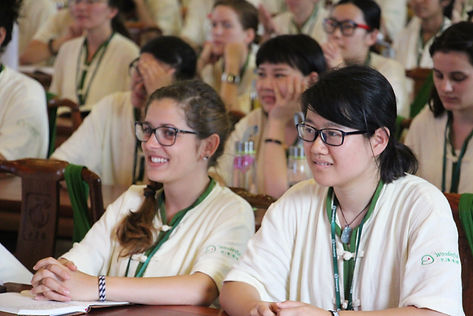
The Woodenfish Monastic Life Program provides international participants a first-hand experience in the daily life, monastic training, and ritual practices of a contemporary East Asian Buddhist monastery.
In addition to direct participation in monastic routines, the Woodenfish experience integrates academic lectures, cultural classes, and organized discussions to provide participants with the historical background and doctrinal frameworks to help better understand the Buddhist experience.
Experiential instruction and classes include:
-
Training in Buddhist monastic etiquette and ritual practice, including formal silent meals, daily chanting services, and seated meditation
-
Introductory coursework addressing key dimensions of Buddhism, such as history, art, philosophy, and ethics
-
Cultural workshops led by experienced practitioners and artists; past offerings have included classical music, tea ceremony, kung fu, taiji, calligraphy, and other traditional arts
-
Communal labor and leisure activities designed to foster meaningful interaction with monastics and lay practitioners within the monastery
-
Daily participation in essential monastic routines, including shared responsibility for living spaces, attention to cleanliness and order, adherence to scheduling to foster a sense of shared timeliness
-
Completion of an intensive, multi-day silent meditation retreat emphasizing sustained contemplative practice
-
All instructional activities are conducted in English
![Photo 04 [Kim Dembrosky].JPG](https://static.wixstatic.com/media/cc2a1d_ff483e46a1434920ac41b523442b2bc1~mv2.jpg/v1/fill/w_486,h_324,al_c,q_80,usm_0.66_1.00_0.01,enc_avif,quality_auto/Photo%2004%20%5BKim%20Dembrosky%5D_JPG.jpg)
![Photo 03 [Kim Dembrosky].jpg](https://static.wixstatic.com/media/cc2a1d_b501f0572dc64413b10776af68d87570~mv2.jpg/v1/fill/w_470,h_324,al_c,q_80,usm_0.66_1.00_0.01,enc_avif,quality_auto/Photo%2003%20%5BKim%20Dembrosky%5D.jpg)
Program Details
General Program Schedule
The Woodenfish Monastic Life Program is conducted over the course of one month and can be divided into three phases.
Phase I - Orientation, Academic & Cultural Classes (~first 3 weeks)
-
Communal monastic life: Participants are instructed in group assembly protocol, shrine hall, meditation hall, and dining hall etiquette, dormitory protocol, and the standards of Buddhist monastic ethics. These are the same disciplinary expectations as monks and nuns who live in a contemporary Buddhist monastery.
-
Morning classes: Academically-oriented morning classes introduce Buddhist history and doctrine and are taught by lay scholars and/or Buddhist monastics. The classes provide participants the opportunity to ask questions and initiate discussion.
-
Meditation classes: To prepare for the week-long meditation retreat (see Phase II), participants will be instructed in sitting Buddhist meditation. No previous experience of meditation is expected.
-
Afternoon classes: Experience-centered afternoon classes focus on applied Buddhism and traditional culture, including calligraphy, the tea ceremony, or an introduction to traditional Asia musical instruments.
-
Evening discussion & Dharma talks: In the evenings, further group discussion will be held or senior monastics will give talks on their areas of expertise
-
Rest Days: There will be half-day or whole day breaks with limited structure interspersed during this phase. There are no “off days,” however, nor should students expect to travel from the monastery freely during the program.
Example of a typical day:
o 04:30 AM Wake-up Call
o 05:00–06:20 AM Movement Class & Morning Meditation
o 06:30–07:00 AM Breakfast
o 07:30–10:30 AM Academic Classes on Buddhism
o 11:00–11:30 PM Lunch
o 11:30–01:00 PM Personal Time
o 01:00–02:00 PM Sitting Meditation
o 02:00–3:30 PM Cultural Classes & Community Service
o 05:00–5:30 PM Medicine Meal (Dinner)
o 06:00–07:00 PM Dharma Talk/ Group Discussion
o 07:15–08:00 PM Evening Chanting (Vespers)
o 08:00 - 09:00 PM Personal Time
o 09:00 PM Lights Out
Phase II - Meditation Retreat & Pilgrimage (~5 days)
-
Intensive silent meditation retreat: With a grounding in monastic disciple and training in meditation, participants are prepared to enter the intensive silent meditation retreat. The retreat lasts five days and participants are expected to maintain “noble silence” throughout its duration. The retreat involves six to eight one hour-long meditation blocks which involve both sitting and walking meditation.
-
Pilgrimage: The culmination of the retreat is a “three steps, one prostration pilgrimage” in the vicinity of the monastery.
Phase III - Graduation and Departure (~2-3 days)
-
Closing ceremony and graduation: Before leaving, we will hold a closing ceremony to thank the host temple and celebrate the graduation of the participants
-
Departure & cultural tour: Some years, depending on location and logistics, the last days include visits to other temples or important cultural and religious sights. Some is conducted in a group, some will be free time. Minor expenses for entrance and food might occur. Details about a cultural tour will be provided on a later date.
Accommodations
-
Room and board are covered under the sponsorship of the Woodenfish Foundation and thus are no extra cost to participants. Due to the intensive nature of the program, dependents (spouses, children, and/or partners) will not be able to accompany participants.
Rooming
-
Students live in dormitories or shared rooms on the monastery grounds, there are no single occupant rooms. Should a student fall ill, we will have a quarantine room available.
Food
-
Three vegetarian meals will be served in the main dining hall where students will be taught proper monastic dining etiquette. All communal meals are eaten with chop-sticks. Please also consult the Food & Food Allergies section below.
Fees & Waivers
Thanks to our donors, every accepted student automatically receives a scholarship that covers room & board, group transportation, and most fees during cultural tours. We estimate each participant receives approximately $7000 USD in value. There are, however, some costs that must be covered by participants; this includes the following:
Program Fees
-
Application Fee: There is a $12 USD application fee for all applicants, paid through Paypal. There is no waiver for this fee.
-
Uniform and Supplies Fee: There is a standard $250 USD supplies fee. This purchases two sets of individually tailored uniforms which are kept by the participant. This also includes a few personal items, such as four meal bowls, eating utensils, and carrying bags. This fee is paid upon acceptance to the program. (See also Fee Waivers below.)
-
Administration Fee: A $250 USD administration fee applies only to *non-current college students.* This fee helps subsidize the cost of airfare and stipends for our volunteer staff. This fee is paid upon acceptance to the program. (See also Fee Waivers below.)
-
Deposit: There is a $200 USD participation deposit to be given in cash (US dollars or equivalent) upon arrival at the monastery. This will be returned to participants at the end of program. If a participant leaves the program early or if a participant is expelled this deposit is forfeited. There is no waiver for this deposit.
Participants are responsible for all travel expenses to and from the program (flight, visa, etc.) as well as personal expenses during free time (temple souvenirs, snacks, etc.)
Fee Waivers
-
Administrative Fee Waiver: For currently enrolled college or university students, a waiver is available for the $250 USD Administrative Fee. Students must submit a current 2025–2026 academic transcript (Fall/Winter or Spring) as part of their supplementary application materials. More information regarding how to submit these materials is available on the Application Form.
-
Uniform and Supplies & Administrative Fee Waiver: For ordained Buddhist monastics only, a waiver is available for both the $250 USD Supplies Fee and $250 USD Administrative Fee. In such a case, the participant will be responsible for bringing their monastic robes and will not receive the Woodenfish uniform.
Refunds & Cancelation
-
Request for refunds due to cancelation must be submitted before May 31 as uniforms are individually tailored and accommodations are individually prepared. We will do our best to accommodate your requests.
![Photo 05 [Kim Dembrosky].JPG](https://static.wixstatic.com/media/cc2a1d_ecd99c30a4694a2f92fa05d9b8163626~mv2.jpg/v1/fill/w_479,h_360,al_c,q_80,usm_0.66_1.00_0.01,enc_avif,quality_auto/Photo%2005%20%5BKim%20Dembrosky%5D_JPG.jpg)
![Photo 06 [Kim Dembrosky].JPG](https://static.wixstatic.com/media/cc2a1d_15509334206743589933323fb64fd203~mv2.jpg/v1/fill/w_479,h_360,al_c,q_80,usm_0.66_1.00_0.01,enc_avif,quality_auto/Photo%2006%20%5BKim%20Dembrosky%5D_JPG.jpg)
Application & Submission Process
Application Components
Every prospective participant must submit an Application Packet in full. An Application Packet includes a completed Application Form with Statement of Purpose, required Supplementary Documents, and payment of the Application Fee.
Required Components
-
Statement of Purpose: Explain your qualifications and motivation for participation in the program, and list the benefits the program will provide to your personal, religious and academic development. This is an important part of the application and we ask the applicant to spend some time on this. Successful statements are generally 300–500 words. The statement will be submitted in the application form.
-
Transcripts: While applicants do not need to be current students, we ask that you include you undergraduate and/or graduate transcript(s) in your application. If an official transcript cannot be easily obtained an unofficial transcript is acceptable. *If you graduated more than eight years ago you do no need to include a copy of your transcript.* Your transcript should be sent to applyhbmlp@gmail.com.
Required Components
-
Application Form: This is a Google Form document submitted electronically.
-
Statement of Purpose: Part of the Google Form application includes a Statement of Purpose. Applicants are free to compose their statement ahead of time and copy/paste into the form. Here is the Statement of Purpose prompt:
Explain your motivation for participation in the Woodenfish Monastic Life Program, and address how the program may benefit your academic, personal, or professional development, or a combination thereof. Applicants are encouraged to reflect on how they understand and anticipate the experience of living communally in a monastic environment. Thoughtful discussion of both aspirations and anticipated challenges is welcome. Prior experience with Buddhism or meditation and/or academic coursework in Religious Studies, East Asia Studies, philosophy, etc., may be discussed if relevant, but is neither required nor expected. The selection committee values sincerity, clarity of purpose, and thoughtful engagement with the aims of the program. Statements should be approximately 300 to 500 words.
-
Supplemental Documents: These materials are required to help confirm the identity of the applicant and help the selection committee ensure diversity among the participants as well as help our instructors tailor potential teaching content.
Applicants have two options:
-
Undergraduate and/or Graduate Transcripts: If you are currently enrolled in an undergraduate or graduate program, or if you graduated within the past five years, please provide your transcripts. If an official transcript cannot be easily obtained, an unofficial version is acceptable. Current transcripts from the previous Fall/Winter or Spring are required to receive the Administrative Fee Waiver.
-
Current Resume/CV: If you did not attend college or graduated college six years ago or more, please send us a resume or curriculum vitae pertaining to your employment and/or career.
Applicants need only send one of the listed documents. If an applicant has graduated recently, within the past five years, they are free to send both their transcripts and current resume/CV, but this is not required.
The Application Form will instruct applicants where to send their supplementary documents.
Optional Components
-
Letter of Recommendation: A recommendation email from your advisor, professor, employer, colleague, or a Woodenfish alumni will benefit your chances of admission, but one is not required.
-
Letters of recommendation should address the applicant's character, maturity, and/or potential academic exposure to Buddhism, Religious Studies, or relevant coursework for participation in a residential program in a Buddhist monastic environment. Recommenders are encouraged to comment on qualities such as sincerity, reliability, openness to learning, capacity for reflection, and ability to live and work harmoniously in a communal setting. Academic, professional, or religious context may be discussed as relevant.
-
Letters should be no more than 300 words.
-
Please have your letter writer send your letter to the selection committee directly through e-mail to applyhbmlp@gmail.com and indicate your name in the subject line. If circumstances require it, however, the letter can be sent to us via the applicant.
Eligibility and Selection
We accept applications from people regardless of religious background, race, or country of origin. Applicants from diverse religious and academic backgrounds are encouraged to apply.
While a majority of participants are working toward an undergraduate or graduate degree, we encourage anyone with an interest in Buddhism, Buddhist meditation, or monasticism to apply. Most of our participants are between 18 and 40 years of age. We equally consider applicants over 40 if you have some form of meditation experience/practice or professional employment in academic Religious Studies programs (or equivalent) and have the physical capacity for intensive daily activities during the Woodenfish program.
Applications are reviewed by a panel of monastics and staff members. In the committee’s evaluation, emphasis will be placed on personal motivation and how the experience with the Woodenfish program can benefit your future goals, both professional and personal.
![Photo 08 [Kim Dembrosky].JPG](https://static.wixstatic.com/media/cc2a1d_cf4022e48fef4e2dba2fc210d18a5c9d~mv2.jpg/v1/fill/w_473,h_316,al_c,q_80,usm_0.66_1.00_0.01,enc_avif,quality_auto/Photo%2008%20%5BKim%20Dembrosky%5D_JPG.jpg)
Additional Information
Visas
The Woodenfish program does not secure visas for participants. Each participant is responsible for determining visa requirements for travel from their home country to the host country. The Woodenfish Foundation cannot issue visa support or invitation letters. Most participants enter on tourist visas. In limited cases, the host monastery may provide a letter at its own discretion. Requests for a monastery letter must be made in a separate email to the Woodenfish applications team well in advance of travel.
Please note: Since the COVID-19 pandemic, some nationalities remain restricted or prohibited from entering certain countries. Before applying, applicants should independently verify current travel eligibility from their country of citizenship, including visa requirements and limitations.
Food & Food Allergies
The Woodenfish program rotates host monasteries every few years. All meals are determined by the host monastery and prepared for the full monastic community, not just our program. Meals are Buddhist vegetarian and often predominantly Buddhist vegan. Meat, fish, alcohol, and related products are strictly prohibited on monastery grounds in accordance with monastic regulations.
Please be aware that cultural culinary differences regarding food ingredients, flavors, and cooking styles may be different from what you are accustomed. Flexibility and openness are essential.
Because meals are prepared communally, food cannot be adjusted to accommodate participants with food allergies or special dietary needs. While occasional ingredient labeling might be possible, consistency and reliability cannot be guaranteed.
Wheat and other gluten-based products, soy, and peanuts are staples in most Asian Buddhist monasteries, if consuming these or other allergens might be life-threatening, we ask that you do not apply to our program as we cannot ensure your dietary safety.
Monastery Etiquette & Buddhist Ethics
Monastic life emphasizes simplicity, modesty, discipline, and communal awareness. These structures are designed to foster self-reflection and mindfulness in daily conduct and in interactions with others. While this environment may feel unfamiliar or challenging at times, it is central to the Woodenfish experience. All participants are expected to observe the following:
Observing the Precepts
While on monastery grounds, participants must observe the Buddhist Five Precepts, or basic lay ethical commitments.
-
Do not kill.
-
Do not steal.
-
Do not lie.
-
Do not engage in sexual or romantic conduct/
-
Do not consume intoxicants (alcohol, recreational drugs, cigarettes, etc.). Nicotine patches are allowed.
Be a Guest First
The monastery is a living religious community. Participants are guests in the monastics’ home and are expected to behave respectfully, modestly, and appropriately at all times. We do not expect participants to arrive fully versed in monastic etiquette or cultural norms. Guidance and feedback may be offered throughout the program to support learning and communal harmony.
Monastic Life is Structured
Daily life during the Woodenfish program follows a strict schedule of communal activities. This monastic-style training emphasizes acting as “one body” in recognition that individual actions affect the entire group. This means arriving to scheduled activities on time, being dressed in uniform when necessary, and lining up and standing in formation while waiting silently for further direction. This structure acts as a mirror of the mind and supports accountability, mindfulness, and awareness of one’s impact on others.
While not every aspect of daily life during the program is strictly managed – there is plenty of personal time in the daily schedule – this structure may feel rigid or inconvenient at times. One hope of the Woodenfish program is to show how structure directly supports practice and can feel, perhaps paradoxically to some, rather freeing.
Privacy is Limited
Participants should expect very limited personal privacy as you will be with other participants nearly 24 hours a day. Sleeping arrangements are modest and typically dormitory-style. Expect to wake, eat, practice, and sleep at the same times as the group.
There are no full days “off” or “free days” during the month-long program. Personal time, however, is built into the schedule for rest, reading, walking, conversation, or quiet reflection.
Head Shaving
Participants are not required to shave their heads nor wear monastic robes as is usually expected of monastics-in-training programs. Participants have the option to shave their heads and this is typically organized sometime during the first week of the program. In rare cases, depending on the customs and level of conservatism of the host monastery, head shaving may not be offered.
Secular Clothing & Personal Care Products
Participants are responsible for bringing personal care products and appropriate, modest summer clothing (non-revealing and generally muted in color) for arrival to and departure from the monastery and for any off-site activities where uniforms would not be worn, but still with the presence of monastics. There is ample time during the day and/or night for personal hygiene–since we live in close quarters, regular bathing, washing, etc., is expected. Please bring and use unscented personal products.
Technology Policy
Participants are asked to minimize use of personal technology, including phones, laptops, and music devices. Communication with friends and family should be limited only to the extent that it is necessary and conducted only in appropriate areas to not disturb others.
No technology or external communication is permitted during the week-long intensive silent meditation retreat. Emergency access to personal devices will always be available if needed.
Academic/Religious Nature of the Program
This program is both scholarly and anthropological in nature; we expect all participants to have an open and inquisitive mind. The Woodenfish program is not a “conversion” program coercing participants to become Buddhists or monastics, or to promote any specific teacher or denomination.
The Woodenfish program is, however, an immersive program focused on Buddhist practice set within a monastic Buddhist religious culture; this will feel more “religious” to some participants than others. While we expect each participant to engage in all aspects of the program, including the performance of some Buddhist ritual, we expect no change in personal religious commitment or conviction. All applicants are welcome, regardless of their cultural background or religious beliefs and we are proud to have alumni from many non-Buddhist traditions, including Christianity, Judaism, Islam, Hinduism, secularism, among others.
During the program, staff is always available to help you navigate the experience and contextualize the practices and examine cultural and religious differences. Not all staff are Buddhist and some come from non-religious backgrounds. We encourage you to ask questions during Q&A times and further reflect on aspects of your experience you do not fully understand and engage in further discussions. Our hope is that when you return home you will have had an authentic experience of lived Buddhist monastic practice that promotes further inquiry in your life.
It is impossible to cover all aspects of the “Woodenfish experience,” but hopefully this is enough to help you self-select if this program is appropriate for you at this time.
![Photo 09 [Jacques Brouillette].JPG](https://static.wixstatic.com/media/cc2a1d_ebe61a07c5fa4fc1b71ae4877a5f4031~mv2.jpg/v1/fill/w_473,h_355,al_c,q_80,usm_0.66_1.00_0.01,enc_avif,quality_auto/Photo%2009%20%5BJacques%20Brouillette%5D_JPG.jpg)
![Photo 10 [Kim Dembrosky].JPG](https://static.wixstatic.com/media/cc2a1d_352d387240b9451b828bf3714c1804ee~mv2.jpg/v1/fill/w_473,h_355,al_c,q_80,usm_0.66_1.00_0.01,enc_avif,quality_auto/Photo%2010%20%5BKim%20Dembrosky%5D_JPG.jpg)
Contact Information
For more information on the Woodenfish Monastic Life Program or any questions or concerns not covered in above or in our FAQ, please contact us at applyhbmlp@gmail.com.
Founder of Woodenfish Monastic Life Program

Venerable Yifa
Venerable Yifa, PhD is a Taiwanese Buddhist nun, scholar, and writer. Ordained in 1979, Yifa holds a law degree from the Taiwan National University, a Master's in Comparative Philosophy from the University of Hawaii and a doctorate in religious studies from Yale University. She has been the Dean at Fo Guang Shan Buddhist seminary to provide the education and training to monastics and served as a department head and dean of University of the West in Los Angeles during her tenure at the college. Besides these long term services, Yifa has been a lecturer at Boston University, a faculty member at National Sun Yat-Sen University in Taiwan and taught at McGill University as the Numata visiting professor in the spring of 2005.
Venerable Yifa’s main area research is on Buddhist monasticism and she is the author of The Origins of Buddhist Monastic Codes in China, published by Hawaii University Press in 2002.
Yifa has also been involved in translating sutras from Mandarin to English. Since 2006, she and others have published translations of the Heart Sutra, Diamond Sutra, Ksitigarbha Sutra, Amitabha Sutra and more. Yifa also wrote the works dealing with social issues Safeguarding the Heart—a Buddhist Response to Suffering and September 11 in 2002; reprinted as The Tender Heart in 2007; Authenticity— Cleaning the Junk: A Buddhist Perspective in 2007; Discernment—Educating the Mind and Spirit in 2009. She is also co-author of Benedict’s Dharma: Buddhists Reflect on the Rule of Saint Benedict (2001), by Riverhead, NY; a contributor to the books The Gethsemani Encounter, The Buddha’s Apprentices, and Women Practicing Buddhism: American Experience, the latter edited by Peter Gregory and Susanne Mrozik.
Yifa has participated in many interfaith dialogues such as the Gethsemani Encounter, and contributed to the UNICEF South Asia's Safe Motherhood Project. She has been granted numerous awards including “the Ten Outstanding Young Persons” in Taiwan in 1997, “Outstanding Women in Buddhism Award” in 2002 bestowed by the UN in Bangkok, and 9th annual “Juliet Hollister Award” in 2006 which was granted at the United Nations New York Headquarters, for her contribution to World Peace and Interfaith Education.
Venerable Yifa now is an independent scholar. In 2002, she established the Woodenfish Project to conduct the “Humanistic Buddhist Monastic Life Program” for college students to experience life in monasteries, as well as “Buddhism in China—Buddhist Seminars in Sacred Sites” for scholars and graduate students. In recent years, the Woodenfish Project has developed more programs between Asia and the West, such as “Buddhism Science and Future” to bring dialogue between scientists, scholars, and practitioners, “World CitiZen” to educate teenagers. The Woodenfish recently co-organizes a new project on Buddhist Voice on Climate Crisis with Buddhadoor and Sumeru Publication in 2022 and works with Amitofo Care Center on a field trip study on “Humanistic Buddhism in Africa” in coming summer of 2023.
The Woodenfish Foundation, served as Woodenfish Project branch in American, has received the special consultative status for Economic and Social Council at United Nations in 2016, then be able to create programs like “United Nations Internship” for Youth leadership and “UN Women conference participation” for women’s voice.
Venerable Yifa is currently affiliated with Asia Center at Harvard University as Associate Visiting Scholar to seek more collaboration with academic worlds to create education and training projects for Buddhist leaders.